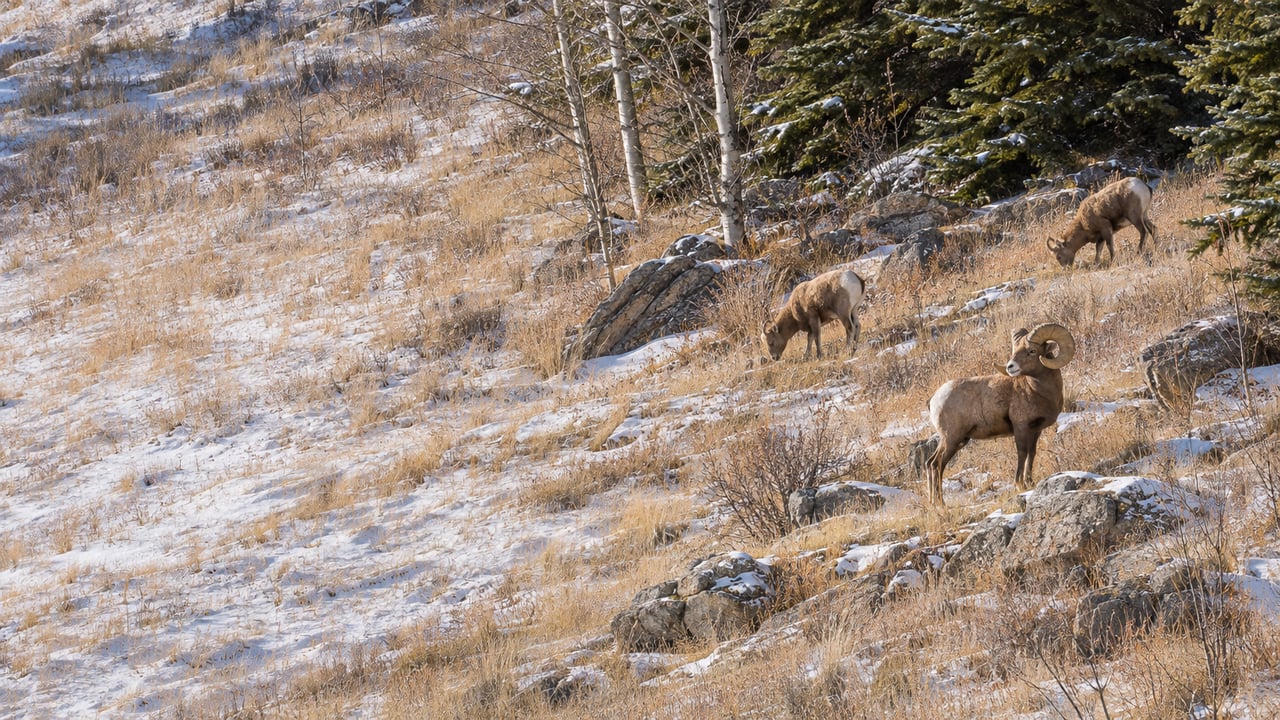
Vail Bighorn Preserve, in East Vail, there is a cliff that rises above North Frontage Road where the low winter sun reaches its south-facing slopes. The Eagle Valley Land Trust says generations of bighorn sheep have stood on that cliffside, "basking in the low winter sun," while the valley below went from ranchland to an international resort in about 65 years. This rut season, the sheep come down to street level.
The hillside land was at the center of the long Booth Heights debate is now the Vail Bighorn Preserve. A state wildlife project is also scheduled to make that range better for the animals.
Why the herd shows up in November
According to the Eagle Valley Land Trust's May 2026 article on bighorn ecology, the bighorn mating season runs from November into December. That is also when the animals move down from high summer terrain to lower winter range. The land trust says this is the time of year when the sheep are most likely to come into contact with people.
The animals arriving in East Vail are a subpopulation of the Gore Range herd. The land trust says this group plays an important part in the genetic diversity of the wider population. In winter they come to the slopes above North Frontage Road for grasses, shrubs and mineral-rich soil. The same land supports elk, mule deer, mountain lions, black bears, lynx and golden eagles.
A Vail Daily wildlife column on the fall rut puts bighorn sheep among the large animals whose mating season is easy to see in Eagle County. It explains the timing: females bred in the fall give birth in spring, when the weather is milder and new growth is coming in. The lambs from this year's rut will arrive next spring, after their mothers have spent the winter on the slopes above East Vail.
The hillside's future is decided
The preserve is made up of four town-owned parcels on the north side of North Frontage Road, just west of the East Vail interchange. One conservation easement covers all 146.9 acres, and the Eagle Valley Land Trust holds it. The land trust says the parcels will be managed as one natural area.
The preserve came together over several years. Vail Resorts once planned a 165-unit workforce housing complex on 5.4 acres of the 23-acre Booth Heights parcel, and the location in bighorn winter range drew strong public opposition. The town took the property through condemnation, a process that started in 2022. Vail Resorts dropped its appeal in October 2024 and agreed to work with the town and East West Partners on a housing project and base village in West Lionshead. That history is laid out in Vail Daily's July 2025 report on the finalized easement.
The town paid $17.5 million for the 5.4 buildable acres and the 17.9 acres that had been set aside as open space. It then added two town-owned parcels of 93.3 and 30.2 acres, one on each side of Booth Creek. Eagle County put $5 million from its Open Space Program toward the preserve. Vail Daily reported that the Town Council finalized the easement on July 1, 2025. The land trust says the last document was signed on September 30, 2025.
The habitat work scheduled through June 2027
When the town brought in wildlife experts to study the Booth Heights land, it found the herd was shrinking. Vail Daily reported in March 2026 that a wildlife biologist told the town in 2019 the latest count was 41 sheep, down from 125 in the 1990s. Those numbers led the town to look at whether better habitat could help the herd recover.
On March 17, 2026, the Vail Town Council took up Resolution No. 7, an agreement with Colorado Parks and Wildlife on what the town's packet calls the Bighorn Sheep Winter Range Enhancement Project. Its other name is the Booth Creek Fuels Project. The item came from Kristen Bertuglia of the town's Environmental Sustainability department. According to the town memo, CPW applied to the state's Auction Raffle program for $600,000 and received $300,000, and the town pledged another $100,000.
As Vail Daily described CPW's summary, the treatment area covers about 3,059 acres. About 548 acres of that is hand-crew cutting, which is meant to improve more than 1,200 acres of bighorn range. CPW's schedule divides the work into nine units, starting in May 2026 and finishing in June 2027, at a total cost of nearly $400,000.
The goals are specific to how bighorn sheep live. The plan aims to restore the shrublands, grasslands and aspen stands the animals feed in. It also aims to open up sightlines so the sheep can spot predators sooner, and to improve the corridors they use between summer and winter range. In practice, the sheep coming down this month are on protected land, and the slopes around it are in the middle of a project designed for them. The schedule runs through next June, so this winter falls in the middle of it.
Watching from outside the fence line
The land trust lists the Vail Bighorn Preserve as having no public access. Anyone who spots the sheep this winter will be seeing them from outside its boundaries.
In Vail Daily's Wildlife Roundtable column on respecting wildlife, local writers name four habits that make the biggest difference. Follow trail closures, keep your distance, keep dogs and cats on a leash, and secure your trash. According to the land trust, November and December are the months when bighorn sheep are most likely to come into contact with people.
Fernanda Landeros grew up in the Vail Valley and wrote the land trust's ecology article. She recalls her mother calling out, "¡Mira donde andan trepadas!" ("Look where they're standing!"), whenever the family spotted bighorns on small ledges beside the interstate. She writes that seeing them still brings her joy. People who live in East Vail will recognize the moment she describes, when the sheep turn up on ledges that look too small to hold them.
The camera-trap photo of a ram in winter on the land trust's page was taken in East Vail.
A winter walk this week, without the dog
Families who want to learn more about how animals here get through the cold have a free option on publish day. Walking Mountains Science Center holds a Winter Nature Walk at its Avon Campus on Thursday, November 19, at 2 p.m. The walk covers the ecology and winter adaptations of mountain animals. It covers about a third of a mile over an hour, with stops along the way. If there is enough snow, participants use snowshoes, and the center provides snowshoes and trekking poles. Pets are not allowed, and registration is online. More walks in the series are scheduled for November 28 and December 17.
The session is about winter wildlife in general, not the East Vail herd. It is still a good way for kids to learn what the sheep on the Frontage Road cliffs are dealing with between now and spring. For more cold-weather ideas around town, see our guide to Vail winter outdoor adventures. Our East Vail neighborhood page has more on the properties that are near the preserve, near the creek, near the school and parks and near the free bus to Vail Village.
The Vail Valley Team, knows East Vail, having lived there for 17 years. If you are thinking about an East Vail property and want to know about the benefits of owning a home, schedule a time to meet with Teri or Joanna, Vail Valley Team at Engel & Volkers. [email protected]